
Finance is built on decisions: what has happened, what needs attention and what we should do next. The work behind those decisions can sometimes be repetitive – collecting information from different places, checking it, preparing a response or bringing a forecast together. That is where AI can help. But an AI tool does not improve a process simply by being switched on – ways of working have to evolve alongside it.
At Checkout.com, we’re an AI-first company. We equip our people with leading AI tools to drive innovation in their daily work, while building agents at scale to transform processes. Crucial to our success is bringing our people along on this AI change journey, fostering a culture where AI augments human capability rather than replacing it. In Finance, we put this into practice through three connected pillars: upskilling our teams to build confidence, proving wins in real workflows, and leveraging those lessons to transition toward a more agentic, strategic Finance function.
This article covers three examples of AI programs within Finance at Checkout.com.
Agent X: Scaling merchant support with faster data retrieval
When a merchant or internal stakeholder asks us about a payment, we need to be able to provide detailed, accurate answers. My team and I designed Agent X to streamline repeatable data retrieval and contextualization in an automated workflow. This enables team members to redirect their time and domain knowledge to higher-value tasks.
Resolving payment inquiries is a multi-step process. Although a question may be simple, the answer must be thorough. An appropriate response requires gathering reliable records, synthesizing key context, and communicating details clearly. The primary challenge lies in uncovering accurate information and interpreting its significance.
Agent X uses a large language mode to analyze incoming queries, translate them into actionable, deterministic database queries, and generate clear, merchant-ready responses. We intentionally maintain a distinct boundary between automated assistance and human oversight: Agent X handles the tedious task of searching for and structuring data, while a human reviews the draft and takes full responsibility for the final answer.
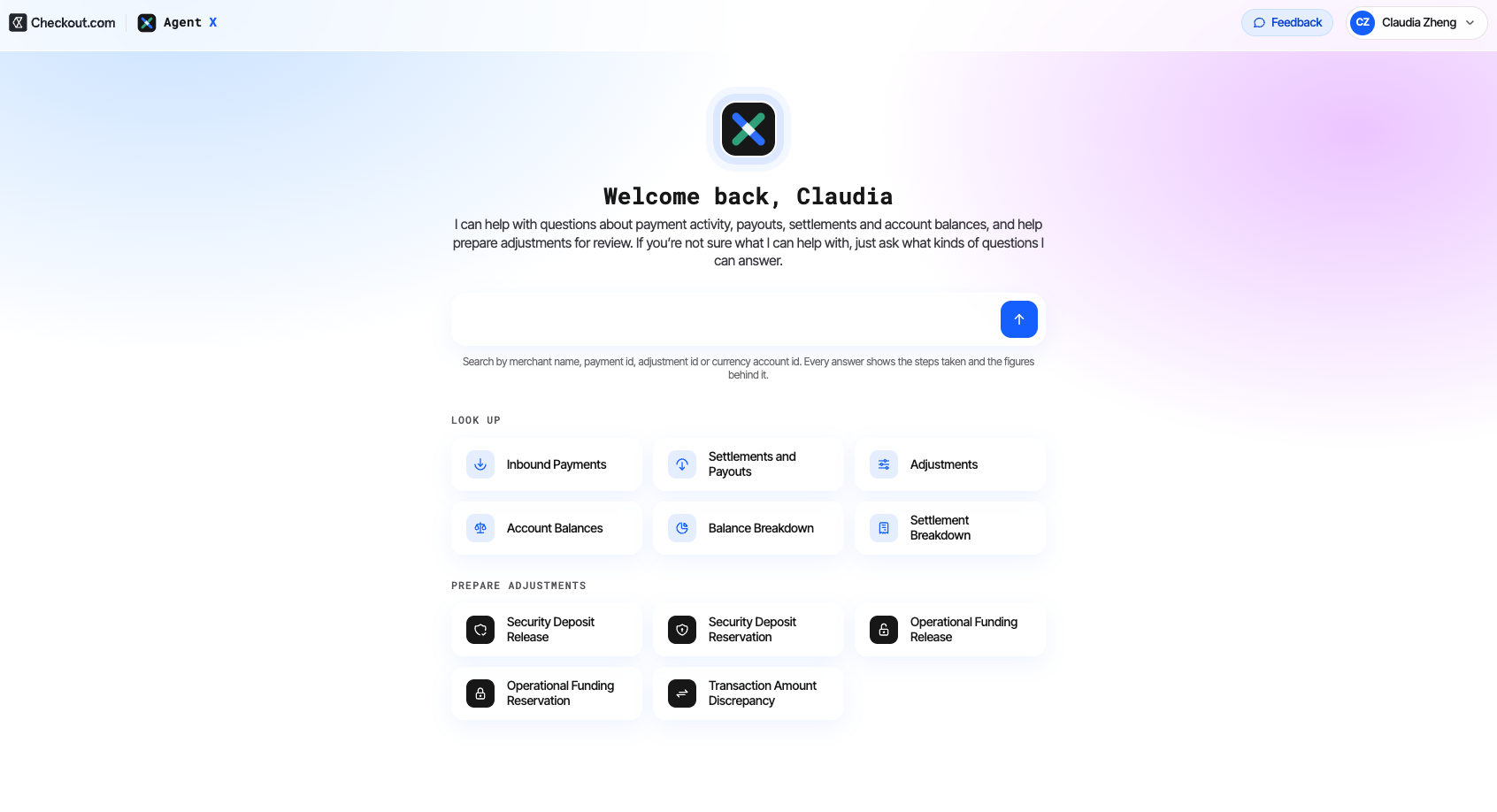
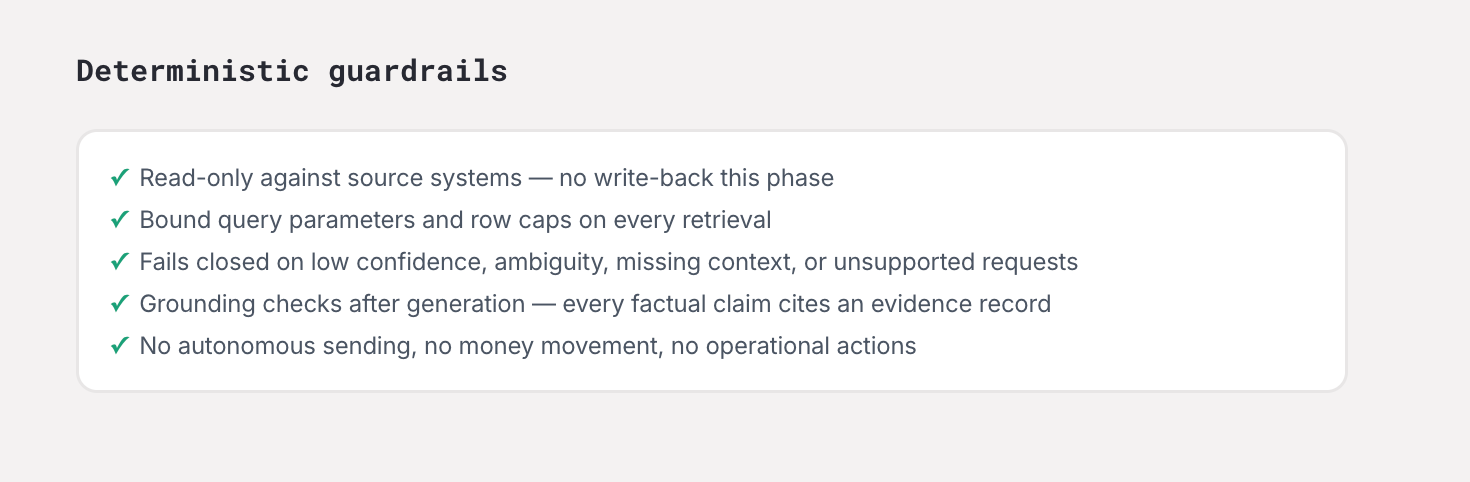
Live across Commercial, Finance and Operation teams, Agent X handles various payment enquiries, including explanations and status updates regarding adjustments. Instead of relying on manual searches across data tables, the agent retrieves relevant financial context, generates deterministic SQL logic for relevant data tables, and presents every step of its process alongside a draft response. The core business logic governing these workflows is thoroughly tested and the answer accuracy is continuously monitored.
During a pre-launch evaluation, Agent X was tested against over 800 real-world questions over a one-month period, with every response rigorously reviewed by human experts. Under strict accuracy evaluation, the agent achieved a 94.5% success rate.
Today, Agent X processes more than 300 merchant queries every month in our operation, significantly accelerating response times from hours down to minutes. By eliminating roughly 98% of the manual effort involved in data gathering and draft composition, it enables us to offer a better experience to our merchants and operate more effectively at scale.
Agent Max: Strengthening data-led liquidity decisions
Treasury decisions depend on understanding expected cash movements, but that information can sit across different systems and data owners. We built Agent Max to equip our team in Treasury to support even stronger decisions on cash flow and liquidity.
We designed Agent Max to support cash flow forecasting and optimization: it applies AI to relevant cash data to create a forward-looking view, which helps our teams to productively deploy liquidity into value-added services and products for our merchants.
Agent Max pulls information from across thousands of our bank accounts and data warehouse sources, then validates and transforms it into required format for ingestion. It uses machine learning to predict 7-day, 30-day and 90-day cashflow forecasts, and generates meaningful insights for liquidity management and funding decisions.
The solution is designed around Treasury’s day-to-day decisions: when a forecast is reviewed, which decisions it can inform and what to do when expectations differ from actual movements. While the AI agent delivers enhanced analytics to guide these choices, our liquidity management team in Finance actively analyzes the forecasts to establish the appropriate course of action for our funding strategy.
Reaching this point took a lot of careful consideration and agreement on which data should be included, who owns each source, how often it changes, and how to handle information that is missing or late. Expertise from our Treasury team was crucial in defining the sources, interpreting the output, and deciding how shortfall or surplus should be handled.
Upskilling: Bringing people along on the AI change journey
Agent X and Agent Max illustrate why culture and upskilling cannot sit apart from technical delivery. Innovation thrives when human expertise is placed at the center of technological change. We use AI tools to increase productivity in daily workflows. This year, we ran our global Finance AI hackathon and held nine Finance-wide upskilling sessions: productive arenas for colleagues to prototype, share knowledge and collaborate on solutions.
Throughout this upskilling journey, functional teams have achieved impactful wins. In the last few months, over 4,000 hours of capacity have been released to support business scaling. For example, the payroll team previously spent 3 days on payroll posting; with AI-enabled automation and human review, the process now takes only a few hours while preserving expert human oversight.
Although Agent Max focuses on Treasury forecasting and Agent X on streamlining payment query preparation, both adhere to a shared core AI transformation philosophy: apply AI to reduce friction and enhance decision-making, establish workflows grounded in reliable data with clear accountability, and preserve human judgment where it is critical.
While Agent X and Agent Max mark our progress, they represent only a part of our overall Finance AI strategy. We are actively exploring ways to agentify additional core functions, including financial reconciliations. For me, these are the practical meaning of being AI first in our Finance function.